
.webp)
Published: December 4, 2025
Restaurant billing seems simple, but small mistakes in invoices, taxes, and pricing can quietly reduce your profit month after month. Below are the most common billing mistakes restaurants make, why they happen, and practical steps to fix them immediately.
Even a ₹20 error repeated 20 times a day becomes ₹12,000 lost per month. Fixing these mistakes ensures accurate accounts, smoother staff workflow, and higher profit margins.
Table of Contents
- Why Restaurant Billing Mistakes Matter
- 1. Incorrect GST Calculation (SGST + CGST)
- 2. Missing Service Charge, Packaging Fee, or Add-ons
- 3. Manual Calculation Errors (Still Very Common)
- 4. Incorrect Discount Application
- 5. Inconsistent Menu Pricing
- 6. Complimentary Items Not Recorded Properly
- 7. Billing Not Connected With Inventory Tracking
- 8. Not Saving Digital Copies of Bills
- 9. No End-of-Day (EOD) Bill Review
- FAQ: Common Billing Mistakes in Restaurants
- Final Thoughts
Why Restaurant Billing Mistakes Matter
Billing mistakes don't always look big—but they add up quickly. A small error repeated throughout the day can result in significant monthly losses. These mistakes also create accounting discrepancies, customer complaints, and tax-related issues that can harm your business reputation and profitability.
Understanding common billing errors and implementing preventive measures is crucial for maintaining accurate financial records and protecting your profit margins.
1. Incorrect GST Calculation (SGST + CGST)
One of the biggest reasons for revenue leakage is wrong GST calculation. Many restaurants:
- Apply old or incorrect GST rates
- Charge GST on non-taxable items
- Add GST twice
- Miscalculate tax on combos
How to Fix It
- Ensure all items are mapped to the correct GST slab (usually 5% for restaurants without ITC)
- Update your billing format whenever tax rules change
- Create a checklist for staff to avoid duplicate or missed GST entries
Pro Tip: Keep a printed tax reference sheet in the billing area.
2. Missing Service Charge, Packaging Fee, or Add-ons
Restaurants often forget to add:
- Packaging charges
- Add-on toppings
- Extra cheese
- Delivery fees
- Special requests
These small amounts directly affect daily revenue.
How to Fix It
- Make a clear list of additional charges
- Add fields for extra fees in your billing method or format
- Train staff to confirm add-ons verbally before billing
3. Manual Calculation Errors (Still Very Common)
Handwriting bills or manually calculating totals leads to:
- Missed items
- Wrong totals
- Incorrect quantity
- Wrong discount calculations
- Human error during rush hours
How to Fix It
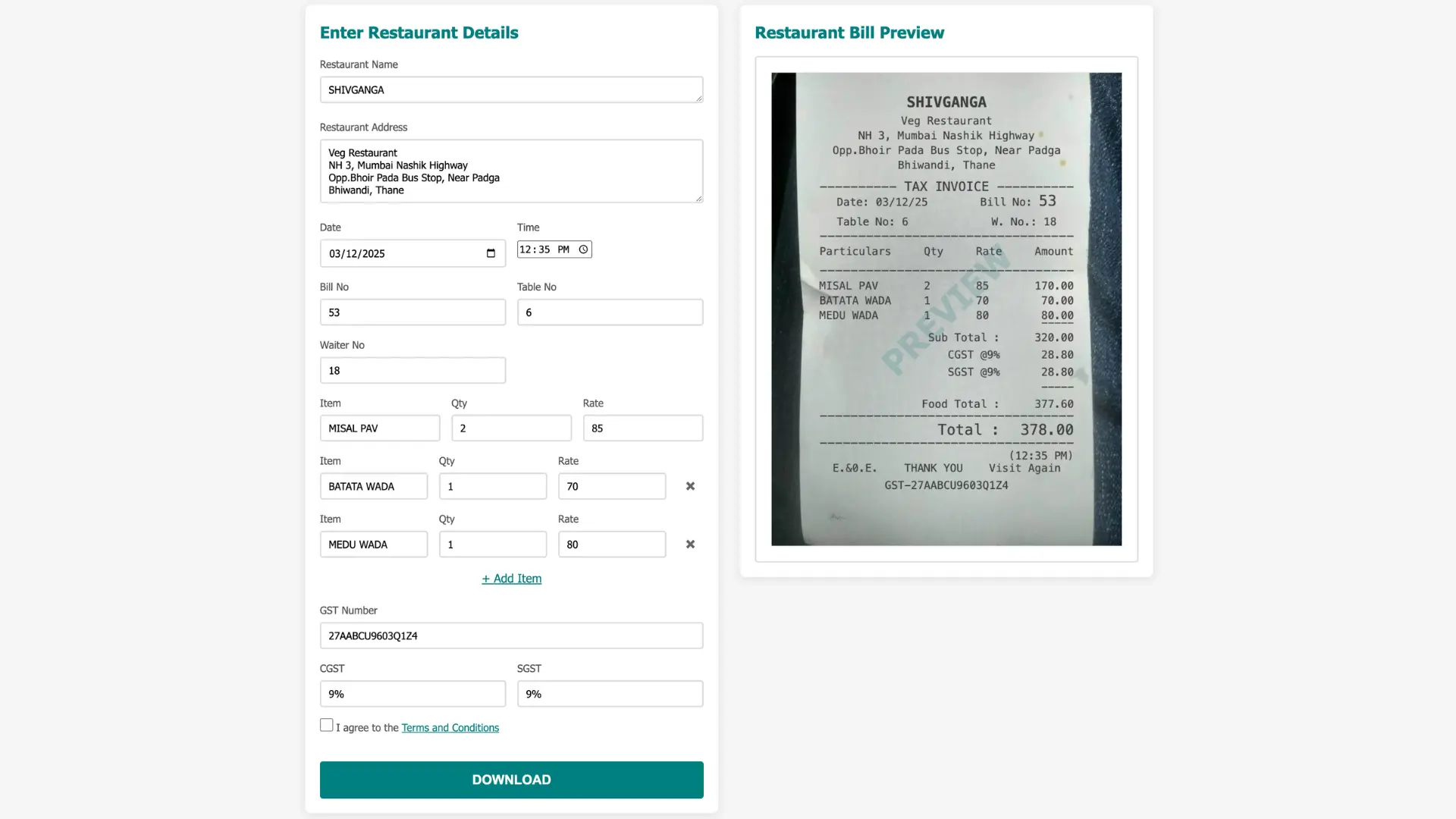
- Use a calculator or automated billing format to avoid arithmetic mistakes
- Double-check totals before printing
- Train new staff on standard billing procedures
4. Incorrect Discount Application
Restaurants frequently misapply:
- Festival offers
- Percentage discounts
- Flat discounts
- Coupon codes
Over-discounting cuts into profit margins.
How to Fix It
- Set a fixed rule for discounts (e.g., "maximum ₹200 off")
- Double-check discount formulas during manual billing
- Maintain a discount log to track all reductions
5. Inconsistent Menu Pricing
If staff manually enter prices, they often forget updated rates. This leads to:
- Undercharging
- Price mismatches
- Customer confusion
- Lower profitability
How to Fix It
- Maintain one central updated price list
- Print updated menus every time prices change
- Share the new price list with all staff weekly
6. Complimentary Items Not Recorded Properly
Complimentary dishes or drinks:
- Are often given without approval
- Are not recorded
- Lead to stock going untraced
How to Fix It
- Record every complimentary item in a bill for transparency
- Set a monthly limit for staff
- Allow only manager-approved complimentary orders
7. Billing Not Connected With Inventory Tracking
A major hidden cause of profit loss is the lack of billing–inventory sync:
- Over-pouring
- Wastage
- Missing stock
- Inaccurate food cost percentage
How to Fix It
- Track stock daily
- Use recipe-based costing for each menu item
- Compare sales vs. stock consumption weekly
8. Not Saving Digital Copies of Bills
If bills are not saved digitally, you lose:
- Historical sales data
- Seasonal trends
- Tax records
- Staff performance metrics
How to Fix It
- Save bills as PDF or Excel files
- Create daily and monthly sales folders
- Use cloud storage for backup
9. No End-of-Day (EOD) Bill Review
Many restaurant owners skip daily bill audits. This leads to:
- Fraud
- Cancelled items not cross-checked
- Wrong totals going unnoticed
- Unrecorded items
How to Fix It
- Review all cancelled, edited, or voided bills daily
- Maintain a simple EOD report (total bills, discounts, complimentary items)
- Make one staff member responsible for end-of-day reconciliation
FAQ: Common Billing Mistakes in Restaurants
1. What are the most common billing mistakes restaurants make?
The most common mistakes include incorrect GST calculation, missing service charges, manual calculation errors, inconsistent pricing, unrecorded complimentary items, and not reviewing bills at the end of the day. These errors reduce profit and create accounting discrepancies.
2. How can wrong GST calculation affect restaurant profit?
Incorrect GST entries may result in undercharging or overcharging customers. Undercharging reduces profit, while overcharging can lead to customer complaints and tax-related issues. Keeping GST slabs updated helps prevent these problems.
3. Why is manual billing risky for restaurants?
Manual billing often leads to calculation errors, missing items, incorrect totals, and misapplied discounts—especially during busy hours. These mistakes cause profit loss and make financial reports inaccurate.
4. How do I prevent staff from giving unnecessary complimentary items?
Set a clear complimentary policy, record all complimentary items in the bill, and require manager approval before giving free dishes. Tracking complimentary items helps control food cost and prevent misuse.
5. Why is digital bill storage important for restaurants?
Saving digital copies of bills helps with tax filing, monthly sales analytics, resolving customer disputes, and detecting staff errors. It also allows you to understand seasonal trends and fast-moving items.
6. What is an End-of-Day (EOD) billing review and why is it necessary?
EOD billing review is a daily check of all bills, including voided, edited, and cancelled bills. This process helps prevent fraud, identify manual errors, and maintain accurate sales reports.
7. How can restaurants avoid inconsistent menu pricing?
Maintain one master price list and update all menus (printed and digital) whenever prices change. Train staff not to enter prices manually unless necessary.
8. Should restaurants charge service charges, packaging fees, or extra toppings?
Yes, if your business model requires it. Additional charges help cover operational costs. Ensure transparency by clearly mentioning these fees in the bill.
9. Can small billing mistakes really affect overall restaurant profit?
Yes. Even small repeated mistakes—like missing ₹10 add-ons or calculation errors—can lead to thousands of rupees lost monthly. Over a year, this significantly impacts profit margins.
10. What is the best way to maintain billing accuracy in a restaurant?
Follow consistent billing procedures, train staff properly, review bills daily, maintain updated pricing, and store bills digitally. These steps help reduce errors and protect profit.
Final Thoughts
Billing mistakes don't always look big—but even a ₹20 error repeated 20 times a day becomes ₹12,000 lost per month. Fixing these mistakes ensures accurate accounts, smoother staff workflow, and higher profit margins.
By implementing the fixes mentioned above, you can significantly reduce billing errors, improve financial accuracy, and protect your restaurant's profitability. Regular training, systematic reviews, and proper documentation are key to maintaining billing accuracy.
.webp)
.webp)