
.webp)
Published: December 4, 2025
Restaurant owners in 2026 face one important decision when setting up billing: Should they use a traditional billing machine, or upgrade to a modern POS system?
Both options help you generate bills, but they offer completely different features, maintenance requirements, and long-term benefits. With digital transformation accelerating in India and globally, choosing the wrong system can impact your speed, accuracy, and profit. This detailed guide explains POS vs Billing Machine, their pros and cons, and which one is better for restaurants in 2026—based on real-world usage, industry trends, and operational requirements.
Table of Contents
- What Is a Billing Machine?
- Advantages of a Billing Machine
- Limitations of a Billing Machine
- What Is a POS System?
- Advantages of a POS System
- Limitations of a POS System
- POS vs Billing Machine (2026 Comparison Table)
- Which Is Better for Restaurants in 2026?
- When Should You Choose a Billing Machine?
- When Should You Choose a POS System?
- Final Verdict: POS vs Billing Machine
- FAQ: POS vs Billing Machine (2026 Updated)
What Is a Billing Machine?
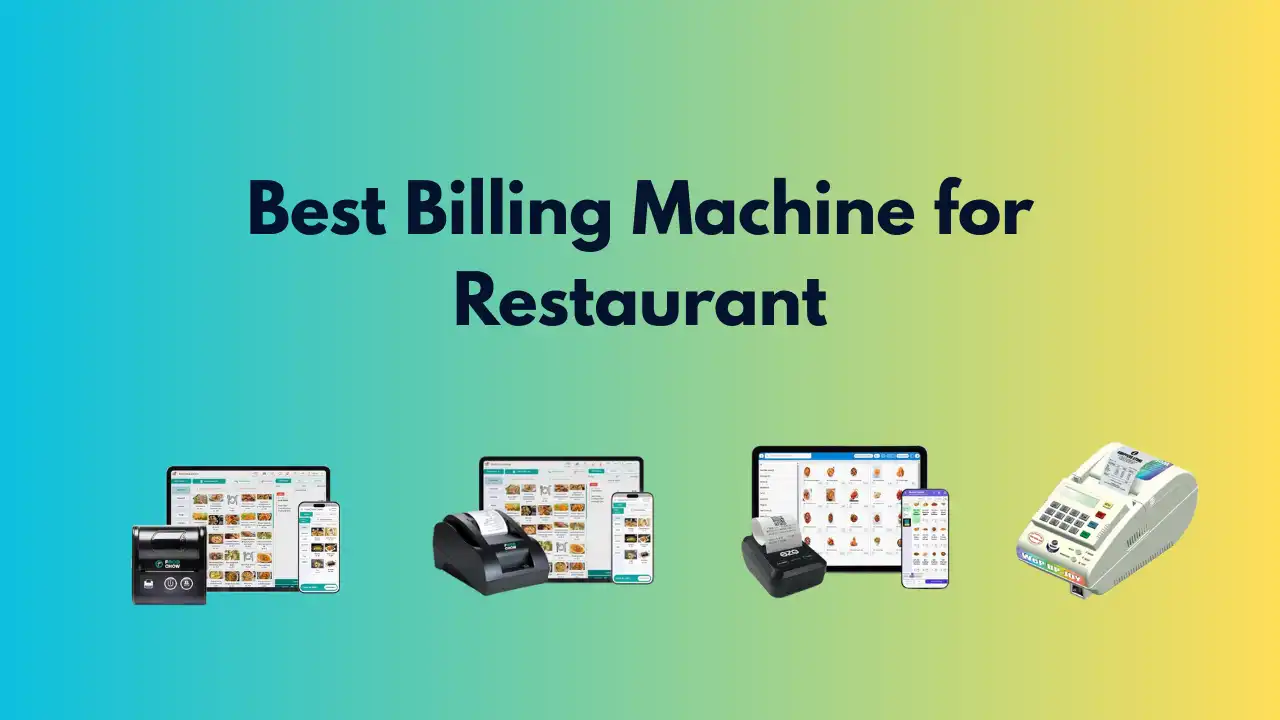
A restaurant billing machine is a hardware device used to generate printed receipts quickly. It usually includes:
- A small display
- A keypad
- A built-in thermal printer
- Pre-loaded items or price entry options
Advantages of a Billing Machine
- Works without internet
- Low power consumption
- Fast bill printing
- Simple to operate
- One-time purchase cost
Limitations of a Billing Machine
- Limited features (basic billing only)
- No cloud backup
- Cannot track inventory
- No sales reports or analytics
- Difficult to update menu prices
- Most models lack GST automation
Billing machines are practical only for very small restaurants, food carts, tea stalls, and low-volume outlets where simplicity is more important than management or tracking.
What Is a POS System?
A POS (Point of Sale) system is a digital billing and business management solution that works on mobile, tablet, PC, or dedicated hardware.
A POS typically includes:
- Billing software
- Cloud database
- Inventory tracking
- Sales analytics
- KOT (Kitchen Order Ticket)
- Staff management tools
- GST-compliant invoice generation
Advantages of a POS System
- Auto GST + discount calculation
- Real-time inventory tracking
- Sales analytics and daily reports
- Menu customization
- Accepts UPI, card, wallet payments
- Cloud backup and multi-device access
- Multi-outlet management
- Reduces manual errors
- Integrates with online ordering platforms
Limitations of a POS System
- Requires internet for cloud syncing
- Monthly subscription fees (for most systems)
- Requires basic staff training
POS systems are ideal for restaurants, cafés, bars, bakeries, cloud kitchens, food trucks, and multi-branch outlets.
POS vs Billing Machine (2026 Comparison Table)
| Feature | POS System | Billing Machine |
|---|---|---|
| Billing Speed | Fast | Fast |
| GST Automation | ✔ Yes | ✘ No |
| Inventory Tracking | ✔ Yes | ✘ No |
| Menu Updates | Easy, instant | Difficult |
| Data Backup | Cloud-based | None |
| Reports & Analytics | Detailed | Minimal |
| Multi-outlet Support | Yes | No |
| Accepts UPI/Card | Yes | Mostly No |
| Staff Access Control | Yes | No |
| Cost | Higher (subscription) | One-time |
| Best For | Growing restaurants | Small outlets |
Which Is Better for Restaurants in 2026?
For 2026 and beyond, POS systems are clearly the better choice for most restaurants. Here's why:
1. More Accuracy & Fewer Billing Errors
POS systems eliminate manual calculation mistakes—especially during rush hours.
2. Better Inventory Control
Inventory wastage is one of the biggest reasons restaurants lose profit. A POS helps track:
- Stock used
- Stock remaining
- Raw material consumption
Billing machines cannot do this.
3. GST-Compliant & Ready for Policy Changes
Government regulations change frequently. POS updates automatically; billing machines do not.
4. Accept All Payment Methods
UPI, card, QR, wallet payments are now essential. Most billing machines do not support this.
5. Multi-Outlet Scalability
If you plan to expand, a POS grows with your business. A billing machine cannot manage multiple branches.
6. Staff Fraud Prevention
POS systems show:
- Voided bills
- Edited bills
- Deleted items
- End-of-day staff-wise reports
Billing machines offer limited tracking.
When Should You Choose a Billing Machine?
Choose a billing machine only if you run:
- A tea stall
- A small dhaba
- A small bakery
- A food cart
- A small fast-food counter with <70 orders/day
If your menu is simple and your billing needs are basic, a billing machine is enough.
When Should You Choose a POS System?
Choose a POS system if you need:
- Faster billing
- GST automation
- Inventory control
- Menu management
- Staff management
- Payment integration
- Business analytics
- Multi-branch control
This is ideal for:
- Restaurants
- Cafés
- Bars
- Cloud kitchens
- QSR (Quick Service Restaurants)
- Franchises
- Large dining establishments
Final Verdict: POS vs Billing Machine
For 2026 and the years ahead:
- POS System = Best Choice for 90% of Restaurants
- Billing Machine = Best for Small, Low-Volume Shops
A POS helps improve speed, accuracy, customer experience, and revenue. Billing machines are inexpensive but limited.
If your restaurant is growing or plans to expand, a POS is the smarter investment.
FAQ: POS vs Billing Machine (2026 Updated)
1. Which is cheaper: POS or billing machine?
Billing machines are cheaper initially, but POS systems offer better long-term value through automation and analytics.
2. Do restaurants need a POS system?
Most modern restaurants prefer POS systems for GST billing, reports, online payments, and inventory management.
3. Can a billing machine calculate GST?
Most traditional billing machines cannot calculate GST automatically, unlike POS systems.
4. Which is better for small restaurants?
Billing machines are fine for small outlets, but POS systems offer more features if you plan to grow.
5. Does a POS require internet?
Some POS systems work offline, but cloud syncing requires internet.
.webp)
.webp)