

Published: January 14, 2026
Every restaurant bill in India must comply with specific legal requirements and include mandatory details to ensure transparency, legal compliance, and proper tax documentation. Whether you're a restaurant owner, manager, or customer, understanding what must be included on a restaurant bill is crucial for legal compliance and avoiding penalties.
This comprehensive guide covers all mandatory details that must appear on every Indian restaurant bill, including GST requirements, legal obligations, and best practices for creating compliant bills.
Table of Contents
- Introduction: Why Mandatory Details Matter
- 1. Restaurant Information (Mandatory Header Details)
- 2. Bill Identification and Transaction Details
- 3. Item Details and Pricing (Mandatory Fields)
- 4. GST Requirements and Tax Details
- 5. Pricing Breakdown and Total Amount
- 6. Payment Information and Transaction Details
- Legal Compliance and Penalties
- GST Registered vs Unregistered Restaurants
- Best Practices for Compliant Bills
- Common Mistakes to Avoid
- Frequently Asked Questions
- Conclusion
Introduction: Why Mandatory Details Matter
In India, restaurant bills are not just receipts—they are legal documents that serve multiple critical purposes:
- Legal Compliance: Bills must comply with GST laws, tax regulations, and consumer protection laws
- Tax Documentation: Required for GST filing, income tax purposes, and audit trails
- Customer Rights: Ensures transparency in pricing, taxes, and charges
- Business Records: Essential for accounting, bookkeeping, and financial reporting
- Dispute Resolution: Serves as proof of transaction in case of disputes or complaints
Missing mandatory details can result in:
- Penalties from tax authorities
- Legal issues and non-compliance charges
- Customer complaints and loss of trust
- Problems during tax audits
- Rejection of input tax credit claims
1. Restaurant Information (Mandatory Header Details)
The header section of every restaurant bill must include complete and accurate information about the restaurant establishment. These details are mandatory for legal identification and compliance.
Mandatory Restaurant Information:
- Restaurant Name: Full legal name of the restaurant or business entity (as registered)
- Complete Address: Full address including street, area, city, state, and PIN code
- Contact Number: At least one contact number (mobile or landline)
- GSTIN (if registered): 15-character GST Identification Number (mandatory for GST-registered restaurants)
Additional Recommended Information:
- Email address (for customer communication)
- Restaurant logo (for brand identity)
- Website or social media handles (optional)
- FSSAI license number (if applicable)
Example of Proper Restaurant Header:
123, MG Road, Connaught Place
New Delhi - 110001
Phone: +91-11-12345678
GSTIN: 07AABCU9603R1ZX
2. Bill Identification and Transaction Details
Every restaurant bill must have unique identification and transaction details for proper record-keeping and legal compliance.
Mandatory Bill Identification Fields:
- Bill Number/Invoice Number: Unique sequential number for each bill (must be unique and non-repeating)
- Date: Date of transaction (DD/MM/YYYY format recommended)
- Time: Time of transaction (HH:MM format, 24-hour or 12-hour)
Additional Transaction Details (Recommended):
- Table Number: For dine-in orders (helps with order tracking)
- Order Type: Dine-in, Takeaway, or Delivery (important for tax purposes)
- Server/Staff Name: Name of the staff member who served (for accountability)
- Customer Name: For delivery orders or if customer requests (optional but recommended)
- Customer Address: For delivery orders (mandatory for delivery)
Important: Bill numbers must be sequential and cannot be skipped. Missing bill numbers can raise red flags during tax audits. Maintain a proper numbering system (e.g., BILL-001, BILL-002, or 2025-001, 2025-002).
3. Item Details and Pricing (Mandatory Fields)
Every item ordered must be clearly listed with complete details. This ensures transparency and helps customers verify their order.
Mandatory Item Details for Each Product:
- Item Name: Clear, descriptive name of the food item or beverage
- Quantity: Number of units ordered (must be clearly stated)
- Unit Price: Price per unit (before taxes)
- Total Price: Quantity × Unit Price (must be calculated and displayed)
Additional Item Information (For GST-Registered Restaurants):
- HSN/SAC Code: Harmonized System of Nomenclature (for goods) or Service Accounting Code (for services)
- GST Rate: Applicable GST rate for each item (e.g., 5%, 12%, 18%)
- Taxable Value: Value on which GST is calculated
Example of Proper Item Listing:
4. GST Requirements and Tax Details
GST (Goods and Services Tax) requirements vary based on whether your restaurant is registered under GST. Understanding these requirements is crucial for compliance.
Mandatory GST Details (For GST-Registered Restaurants):
- GSTIN: 15-character GST Identification Number (format: 2 digits state code + 10 digits PAN + 1 entity number + 1 check digit)
- Taxable Value: Subtotal amount before taxes
- CGST Amount: Central GST amount (for intra-state transactions)
- SGST Amount: State GST amount (for intra-state transactions)
- IGST Amount: Integrated GST (for inter-state transactions, if applicable)
- Total GST: Sum of CGST, SGST, and/or IGST
- GST Rate: Applicable GST rate (commonly 5% for restaurants without Input Tax Credit)
GST Rates for Restaurants in India:
- 5% GST: Restaurants without Input Tax Credit (ITC) - Most common rate
- 18% GST: Restaurants with Input Tax Credit (ITC) - Less common
- 0% GST: Unregistered restaurants (turnover below ₹20 lakhs, optional registration)
GST Calculation Example (5% Rate, Without ITC):
Important Note: For restaurants registered under GST, displaying GSTIN and tax breakdown is mandatory. Failure to include GST details can result in penalties and rejection of input tax credit claims by customers.
5. Pricing Breakdown and Total Amount
A clear pricing breakdown is mandatory to show how the final amount is calculated. This ensures transparency and helps customers understand all charges.
Mandatory Pricing Fields:
- Subtotal: Sum of all item prices (before taxes and additional charges)
- Service Charge: If applicable, must be clearly mentioned (not mandatory but if charged, must be shown)
- Packaging Charge: For takeaway/delivery orders (if applicable)
- Delivery Charge: For delivery orders (if applicable)
- Discount: Any discounts applied (if applicable, must be shown)
- Taxes: All applicable taxes (CGST, SGST, IGST) with amounts
- Grand Total: Final amount payable (must be prominently displayed)
Example of Complete Pricing Breakdown:
Legal Requirement: All charges must be clearly itemized. Hidden charges or unclear pricing can lead to consumer complaints and legal issues. The grand total must be clearly visible and accurate.
6. Payment Information and Transaction Details
Payment information must be recorded on the bill to complete the transaction record and provide proof of payment.
Mandatory Payment Details:
- Payment Method: Cash, Credit Card, Debit Card, UPI, Online Payment, etc.
- Amount Paid: Total amount paid by the customer
- Change Returned: For cash payments (if applicable)
Additional Payment Information (Recommended):
- Transaction ID/Reference Number: For digital payments (UPI, card, online)
- Card Last 4 Digits: For card payments (for reference)
- Payment Time: Time of payment completion
- Payment Status: Paid, Pending, Partial (if applicable)
Legal Compliance and Penalties
Non-compliance with mandatory bill requirements can result in serious legal and financial consequences.
Penalties for Non-Compliance:
- GST Penalties: Up to ₹25,000 for not issuing proper invoices or bills
- Tax Audit Issues: Missing details can lead to tax assessment and penalties
- Input Tax Credit Rejection: Customers cannot claim ITC without proper GST details
- Consumer Complaints: Customers can file complaints for unclear or missing information
- Legal Action: Repeated non-compliance can lead to legal proceedings
Best Practice: Always ensure your bills include all mandatory details. Use professional billing software or online bill generators that automatically include all required fields to avoid compliance issues.
GST Registered vs Unregistered Restaurants
The mandatory details on restaurant bills differ based on GST registration status.
GST-Registered Restaurants (Mandatory Registration if turnover > ₹20 lakhs):
- Must display GSTIN on every bill
- Must show GST breakdown (CGST, SGST, or IGST)
- Must include HSN/SAC codes for items
- Must show taxable value and tax amounts separately
- Must issue proper tax invoices
Unregistered Restaurants (Turnover < ₹20 lakhs, optional registration):
- GSTIN not required (but can be included if voluntarily registered)
- GST breakdown not required
- Still must include all other mandatory details (restaurant info, bill number, items, pricing, payment)
- Must maintain proper records for accounting purposes
Note: Even unregistered restaurants should maintain professional bills with all details (except GST) for proper accounting, customer service, and future compliance if they grow beyond the threshold.
Best Practices for Compliant Bills
Following these best practices ensures your bills are compliant, professional, and customer-friendly.
1. Use Professional Billing Software
Invest in reliable POS systems or online bill generators that automatically include all mandatory fields and ensure accurate calculations.
2. Maintain Sequential Bill Numbers
Ensure bill numbers are sequential without gaps. Missing numbers can raise questions during audits.
3. Keep Digital Records
Maintain digital copies of all bills for easy retrieval, backup, and audit purposes. Store them securely for the required retention period (usually 6-7 years).
4. Regular Audits
Periodically review your bills to ensure all mandatory details are present and accurate. Train staff on proper billing procedures.
5. Clear and Readable Format
Ensure bills are printed clearly or displayed properly on digital screens. Use readable fonts and proper spacing.
Common Mistakes to Avoid
Avoid these common mistakes that can lead to compliance issues and penalties.
- Missing GSTIN: GST-registered restaurants must display GSTIN on every bill
- Incorrect GST Calculation: Wrong tax calculations can lead to penalties
- Missing Bill Number: Every bill must have a unique sequential number
- Unclear Item Descriptions: Items must be clearly named and described
- Hidden Charges: All charges must be clearly itemized and visible
- Missing Date/Time: Transaction date and time are mandatory
- Incomplete Address: Restaurant address must be complete with PIN code
- No Payment Details: Payment method and amount must be recorded
- Skipped Bill Numbers: Missing sequential numbers raise audit concerns
- Illegible Printing: Bills must be clear and readable
Frequently Asked Questions
1. Is GSTIN mandatory on all restaurant bills?
GSTIN is mandatory only for restaurants registered under GST (typically those with annual turnover above ₹20 lakhs). Unregistered restaurants don't need to display GSTIN, but all other mandatory details are still required.
2. What happens if I miss mandatory details on a bill?
Missing mandatory details can result in penalties (up to ₹25,000 for GST violations), tax audit issues, rejection of input tax credit claims, and customer complaints. It's essential to include all required information.
3. Do I need to show HSN/SAC codes on bills?
HSN (Harmonized System of Nomenclature) or SAC (Service Accounting Code) codes are mandatory for GST-registered restaurants, especially for B2B transactions. For B2C transactions, they may not always be required, but including them is a best practice.
4. Can I skip bill numbers or use random numbers?
No, bill numbers must be sequential and cannot be skipped. Missing or random bill numbers can raise red flags during tax audits and may be considered as an attempt to hide transactions. Use a proper sequential numbering system.
5. Is service charge mandatory on restaurant bills?
Service charge is not mandatory, but if you charge it, it must be clearly mentioned on the bill. According to Indian law, service charge is optional and customers can refuse to pay it. If charged, it must be itemized separately.
6. What is the difference between CGST and SGST?
CGST (Central GST) and SGST (State GST) apply to intra-state transactions (within the same state). Each is half of the total GST rate. For example, if the GST rate is 5%, CGST is 2.5% and SGST is 2.5%. For inter-state transactions, IGST (Integrated GST) applies instead.
7. Do I need to keep copies of all bills?
Yes, restaurants must maintain copies of all bills for accounting, tax, and audit purposes. The retention period is typically 6-7 years. Digital storage is recommended for easy access and backup.
8. Can I use digital bills instead of printed bills?
Yes, digital bills (emailed or SMS) are legally acceptable as long as they contain all mandatory details. Digital bills are eco-friendly and convenient, especially for delivery orders. However, ensure they are properly formatted and accessible to customers.
9. What details are mandatory for delivery orders?
For delivery orders, all standard mandatory details apply, plus customer name and delivery address must be included. Packaging charges and delivery charges (if applicable) must be clearly itemized.
10. How can I ensure my bills are always compliant?
Use professional billing software or online bill generators that automatically include all mandatory fields. Regularly audit your bills, train staff on proper procedures, and stay updated with GST and tax regulations. Consider consulting with a tax professional for complex situations.
Conclusion
Ensuring that every restaurant bill includes all mandatory details is not just a legal requirement—it's essential for maintaining compliance, building customer trust, and avoiding penalties. The mandatory details include:
- Complete restaurant information (name, address, contact, GSTIN if registered)
- Unique bill number, date, and time
- Itemized list with quantities, prices, and totals
- GST details (for registered restaurants)
- Clear pricing breakdown and grand total
- Payment information and transaction details
By using professional billing tools, maintaining proper records, and following best practices, you can ensure your restaurant bills are always compliant and professional. Remember, compliance is not optional—it's mandatory for legal operation and customer trust.
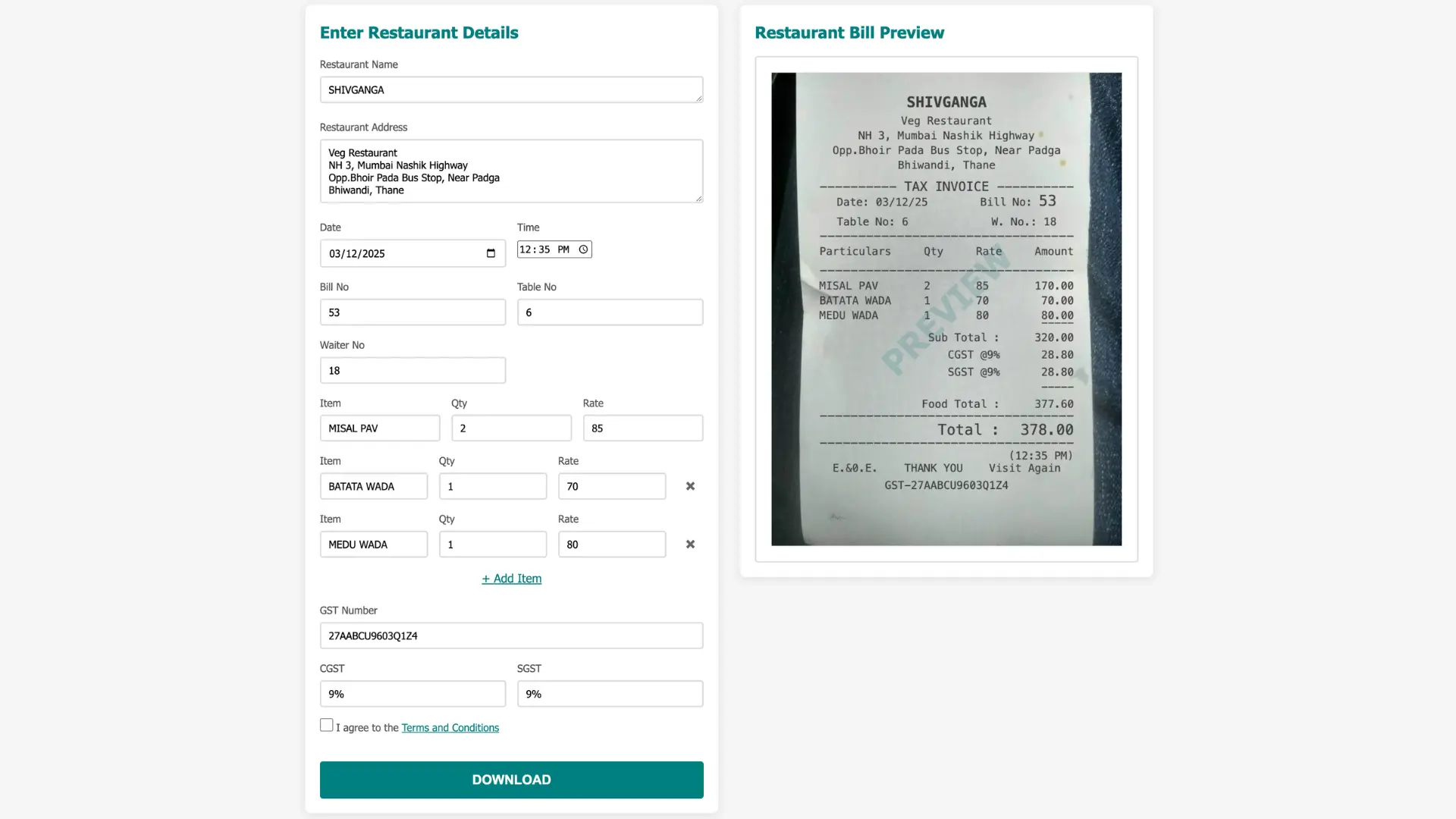
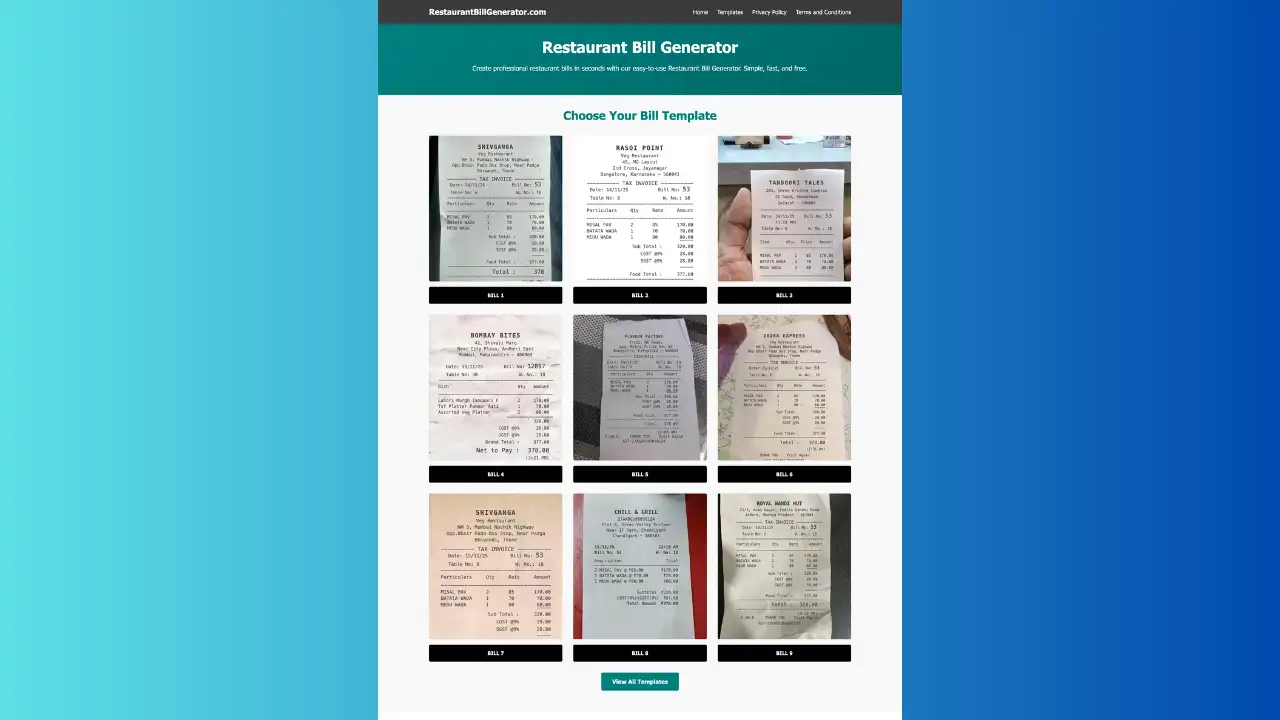
For creating compliant restaurant bills with all mandatory details, use our free online restaurant bill generator that automatically includes all required fields and ensures GST compliance.

.webp)
.webp)
.webp)