
.webp)
Published: December 4, 2025
A well-formatted restaurant bill is more than just a receipt—it's a professional document that ensures legal compliance, builds customer trust, and helps with accurate accounting. Whether you're running a small café or a large restaurant chain, understanding the proper bill format is essential for smooth operations.
This comprehensive guide explains every aspect of restaurant bill format, from essential fields and legal requirements to layout design and best practices. You'll learn how to create bills that are compliant, professional, and user-friendly.
Table of Contents
What Is a Restaurant Bill Format?
A restaurant bill format is the standardized structure and layout used to present invoice information to customers. It includes all necessary details about the order, pricing, taxes, and payment information in a clear, organized manner.
A proper bill format serves multiple purposes:
- Legal Compliance: Meets government requirements for tax reporting and GST filing
- Customer Transparency: Shows itemized charges, taxes, and total amount clearly
- Accounting Records: Provides accurate documentation for bookkeeping and audits
- Brand Identity: Reflects your restaurant's professionalism and attention to detail
Essential Fields in a Restaurant Bill
Every restaurant bill must include specific fields to be complete and compliant. Here are the essential components:
1. Restaurant Information (Header)
- Restaurant name
- Complete address
- Contact number
- Email address (optional but recommended)
- GSTIN (GST Identification Number) if registered
- Restaurant logo (for brand identity)
2. Bill Details
- Bill number (unique invoice number)
- Date and time of order
- Table number (for dine-in orders)
- Order type (Dine-in, Takeaway, Delivery)
- Staff/server name (optional)
3. Item Details
The itemized list should include:
- Item name
- Quantity
- Unit price
- Total price per item (quantity × unit price)
- Add-ons or modifications (if any)
4. Pricing Breakdown
- Subtotal (sum of all items)
- Service charge (if applicable)
- Packaging charge (for takeaway/delivery)
- Delivery charge (if applicable)
- Discount amount (if any)
- Taxes (SGST, CGST, or IGST)
- Grand Total (final amount to be paid)
5. Payment Information
- Payment method (Cash, Card, UPI, Online)
- Amount paid
- Change returned (if cash payment)
- Transaction ID (for digital payments)
6. Footer Information
- Thank you message
- Customer feedback request
- Social media handles (optional)
- Terms and conditions (if applicable)
GST-Compliant Bill Fields
For restaurants registered under GST, the bill format must include specific tax-related fields to ensure compliance:
Mandatory GST Fields:
- GSTIN: 15-character GST Identification Number
- HSN/SAC Code: Harmonized System of Nomenclature or Service Accounting Code
- Tax Rate: Applicable GST rate (usually 5% for restaurants without ITC)
- SGST: State GST amount (half of total GST for intra-state transactions)
- CGST: Central GST amount (half of total GST for intra-state transactions)
- IGST: Integrated GST (for inter-state transactions)
- Total Tax Amount: Sum of all applicable taxes
GST Calculation Example
For a bill with subtotal ₹1,000 and 5% GST (without ITC):
- Subtotal: ₹1,000
- GST (5%): ₹50
- SGST (2.5%): ₹25
- CGST (2.5%): ₹25
- Grand Total: ₹1,050
Restaurant Bill Layout Design
A well-designed bill layout improves readability and creates a professional impression. Here are key layout principles:
1. Header Section
The header should be prominent and include:
- Restaurant logo (centered or left-aligned)
- Restaurant name in bold, larger font
- Contact information in smaller font below
- Visual separator line before bill details
2. Bill Information Section
Display bill number, date, and time clearly:
- Use a two-column layout (Label: Value)
- Make bill number prominent (for reference)
- Include date and time in readable format
3. Item List Section
The item list should be organized in a table format:
- Column headers: Item, Qty, Price, Total
- Left-align item names for readability
- Right-align numbers for easy comparison
- Use consistent spacing between rows
- Add horizontal lines to separate items
4. Pricing Summary Section
Display pricing breakdown clearly:
- Right-align all amounts
- Use bold font for subtotal and grand total
- Show tax breakdown separately
- Add a separator line before grand total
5. Footer Section
Keep the footer simple and professional:
- Thank you message (centered)
- Contact information (smaller font)
- Social media links (optional)
Best Practices for Restaurant Bills
1. Keep It Clear and Readable
Use legible fonts (minimum 10pt), adequate spacing, and high contrast between text and background. Avoid cluttered layouts.
2. Ensure Accuracy
Double-check all calculations, item names, quantities, and prices before printing. Automated billing systems reduce human error.
3. Maintain Consistency
Use the same bill format across all orders. Consistent formatting helps customers understand bills quickly and builds trust.
4. Include All Required Information
Never skip mandatory fields like bill number, date, GSTIN (if applicable), and itemized pricing. Missing information can lead to compliance issues.
5. Use Sequential Bill Numbers
Assign unique, sequential bill numbers for easy tracking and accounting. This helps prevent duplicate bills and simplifies record-keeping.
6. Print on Quality Paper
For printed bills, use good-quality thermal or bond paper. Ensure the print is dark and clear, especially for thermal printers.
7. Save Digital Copies
Maintain digital records of all bills for accounting, tax filing, and customer disputes. PDF format is ideal for long-term storage.
8. Make It Branded
Include your restaurant logo and brand colors to create a professional image. Branded bills enhance customer perception and brand recall.
Common Bill Format Mistakes to Avoid
1. Missing GST Information
If your restaurant is GST-registered, failing to include GSTIN, tax rates, and tax amounts can result in penalties during audits.
2. Incorrect Tax Calculations
Wrong GST calculations (applying incorrect rates, double taxation, or missing taxes) lead to compliance issues and customer complaints.
3. Unclear Item Descriptions
Using abbreviations or unclear item names confuses customers and makes accounting difficult. Always use full, descriptive item names.
4. Missing Bill Number or Date
Every bill must have a unique number and date. Missing these makes tracking and accounting impossible.
5. Poor Layout and Readability
Cramped text, small fonts, or confusing layouts make bills hard to read and create a negative customer experience.
6. Not Itemizing Charges
Showing only a total amount without itemized breakdown creates transparency issues and can lead to customer disputes.
Digital vs Printed Bill Format
Modern restaurants can choose between digital and printed bill formats. Each has its advantages:
Digital Bills
- ✓ Instant delivery via email/SMS/WhatsApp
- ✓ Easy to store and search
- ✓ Environmentally friendly
- ✓ Can include links and QR codes
- ✓ Lower operational costs
- ✓ Better for delivery orders
Printed Bills
- ✓ Traditional and familiar to customers
- ✓ No need for customer email/phone
- ✓ Immediate physical copy
- ✓ Preferred for dine-in customers
- ✗ Paper and printer costs
- ✗ Environmental impact
Recommendation: Many restaurants now offer both options—printed bills for dine-in customers and digital bills for delivery/takeaway orders. This provides flexibility and improves customer satisfaction.
Restaurant Bill Format Examples
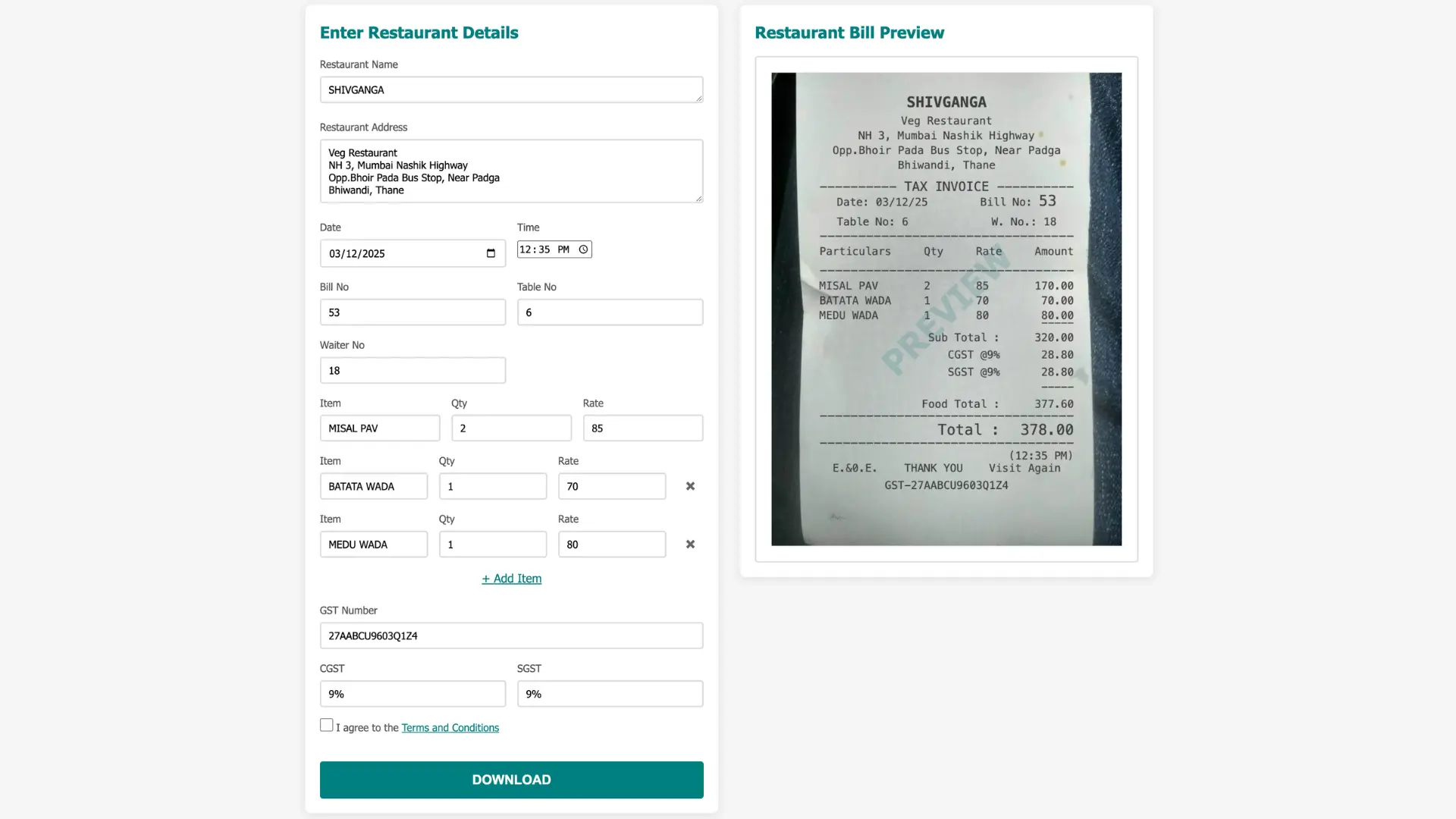
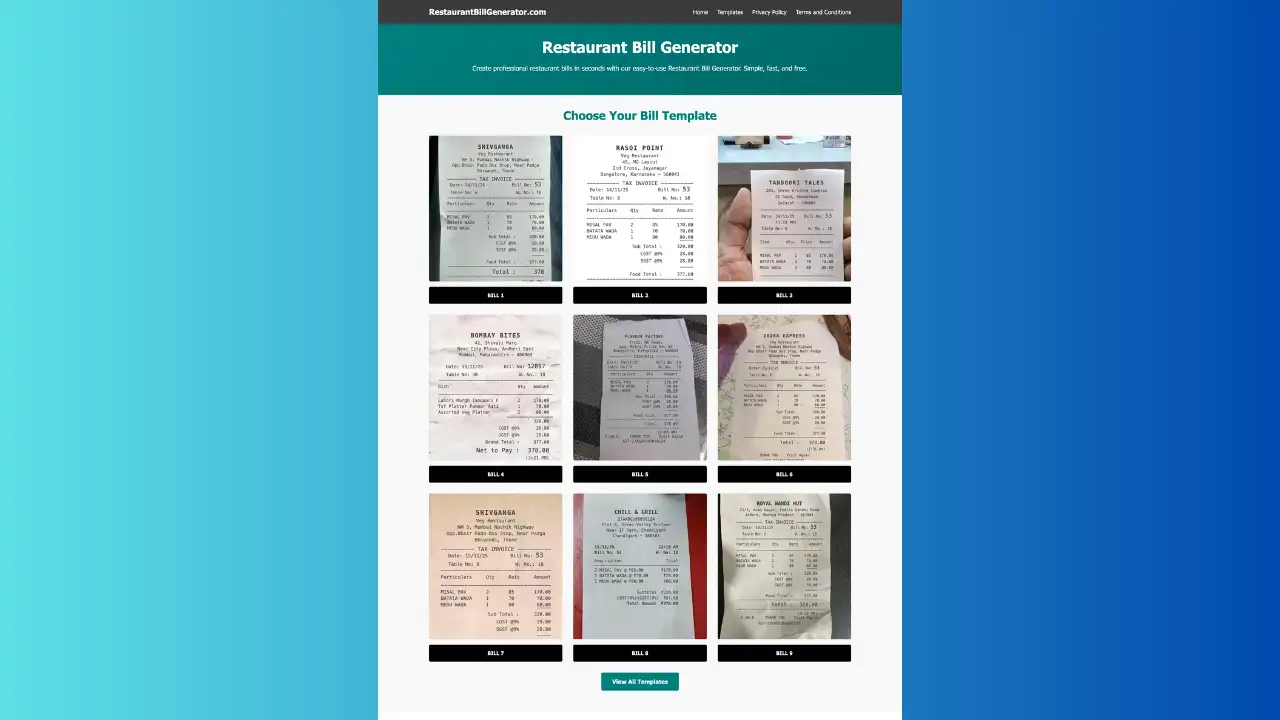
Here are examples of well-formatted restaurant bills for different scenarios:
Example 1: Simple Dine-In Bill
Address, City, State - PIN
Phone: +91-XXXXXXXXXX
GSTIN: 29XXXXXXXXXXXXX
Visit us again soon!
Example 2: Delivery Bill with Charges
A delivery bill should clearly show packaging charges, delivery fees, and any applicable discounts. The format is similar to a dine-in bill but includes additional charges and customer delivery address.
FAQ: Restaurant Bill Format
1. What is the standard restaurant bill format?
A standard restaurant bill format includes restaurant information, bill number and date, itemized list of ordered items with prices, subtotal, taxes (if applicable), and grand total. For GST-registered restaurants, GSTIN and tax breakdown are mandatory.
2. Is GST mandatory on restaurant bills?
GST is mandatory only if your restaurant is registered under GST. If registered, you must include GSTIN, tax rates, and tax amounts on every bill. Unregistered restaurants don't need to show GST.
3. What information must be on a restaurant bill?
Essential information includes restaurant name and address, bill number, date and time, itemized list with quantities and prices, subtotal, applicable charges (service, packaging, delivery), taxes, and grand total. Payment method and amount paid should also be recorded.
4. Can I customize my restaurant bill format?
Yes, you can customize the layout, colors, fonts, and branding elements as long as all mandatory fields are included. Many restaurants use online bill generators or POS systems to create customized, professional bills.
5. What is the difference between SGST and CGST?
SGST (State GST) and CGST (Central GST) apply to intra-state transactions (within the same state). Each is half of the total GST rate. For inter-state transactions, IGST (Integrated GST) applies instead.
6. How do I create a professional restaurant bill?
Use a professional billing software or online bill generator that includes all required fields, ensures accurate calculations, and allows customization. Ensure clear layout, readable fonts, and proper spacing for a professional appearance.
7. Should I use digital or printed bills?
Both formats have advantages. Digital bills are cost-effective, eco-friendly, and convenient for delivery orders. Printed bills are traditional and preferred by many dine-in customers. Offering both options provides flexibility.
8. What happens if I make a mistake on a bill?
If you discover an error, issue a corrected bill or credit note. Never delete or destroy the original bill. Maintain records of all corrections for accounting and audit purposes. For GST-registered restaurants, follow proper credit note procedures.
Conclusion
A well-formatted restaurant bill is essential for legal compliance, customer trust, and efficient operations. By including all mandatory fields, maintaining a clear layout, and following best practices, you can create professional bills that serve both your customers and your business needs.
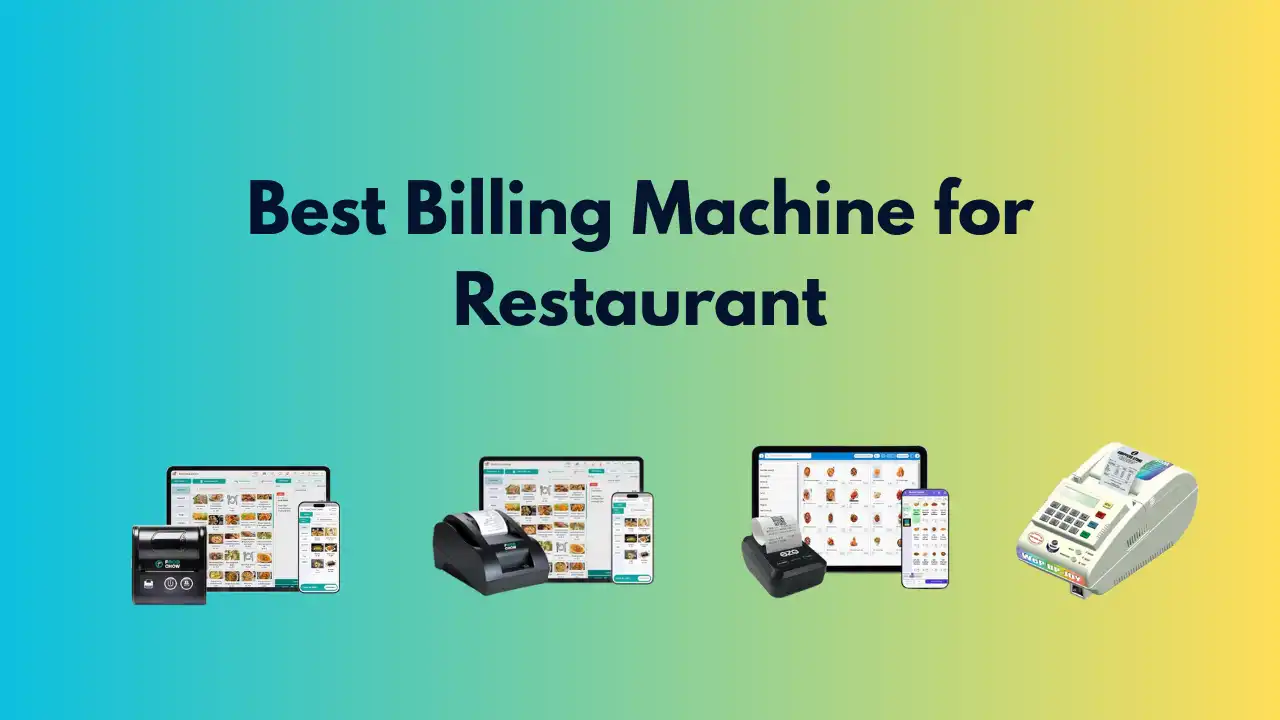
Whether you use a POS system, online bill generator, or manual format, ensure your bills are accurate, compliant, and easy to understand. This not only helps with accounting and tax filing but also enhances your restaurant's professional image.
If you need to create professional restaurant bills quickly, you can use an online restaurant bill generator to create GST-compliant invoices with all required fields and proper formatting.
.webp)
.webp)
.webp)