
.webp)
Published: January 14, 2026
Starting a restaurant business involves much more than great food and service. One of the most critical aspects that startup founders often overlook is establishing a proper billing and accounting workflow. From taking orders to generating profit and loss statements, every step needs to be carefully planned and executed to ensure financial health and legal compliance.
This comprehensive guide walks you through the complete billing and accounting workflow for restaurant startups, covering order management, billing processes, GST compliance, accounting basics, financial reporting, and how to create accurate P&L statements.
Table of Contents
- Introduction: Why Proper Workflow Matters
- 1. Order Management: The Foundation
- 2. Billing Process: From Order to Invoice
- 3. GST Handling and Tax Compliance
- 4. Accounting Basics for Restaurants
- 5. Maintaining Financial Records
- 6. Creating Profit & Loss (P&L) Statements
- 7. Cash Flow Management
- 8. Best Practices for Startup Restaurants
- 9. Common Mistakes to Avoid
- 10. Recommended Tools and Software
- Frequently Asked Questions
- Conclusion
Introduction: Why Proper Workflow Matters
For restaurant startups, establishing a streamlined billing and accounting workflow is not just about compliance—it's about survival. A well-designed workflow helps you:
- Track Revenue Accurately: Know exactly how much money is coming in from each source
- Manage Costs Effectively: Monitor expenses and identify areas for cost optimization
- Ensure Legal Compliance: Meet GST requirements and tax obligations without penalties
- Make Informed Decisions: Use financial data to guide business strategy and growth
- Attract Investors: Professional financial records are essential for funding and partnerships
- Prevent Fraud: Proper workflows reduce the risk of theft and financial mismanagement
Without a proper workflow, restaurant startups often face:
- Cash flow problems due to poor tracking
- GST compliance issues and penalties
- Difficulty in securing loans or investments
- Inability to identify profitable vs. unprofitable items
- Time wasted on manual data entry and corrections
1. Order Management: The Foundation
Order management is the first step in your billing workflow. How you capture and process orders directly impacts billing accuracy and accounting efficiency.
Key Components of Order Management:
- Order Capture: Dine-in, takeaway, delivery, or online orders
- Order Tracking: Unique order numbers for each transaction
- Item Management: Menu items with prices, categories, and GST rates
- Modifications: Handling add-ons, substitutions, and special requests
- Order Status: Pending, confirmed, preparing, ready, completed, cancelled
Order Management Best Practices:
- Use KOT (Kitchen Order Ticket) System: Generate KOTs for kitchen communication and order tracking
- Assign Unique Order Numbers: Every order should have a unique identifier (e.g., ORD-2026-001234)
- Track Order Timestamps: Record order time, preparation time, and completion time
- Handle Cancellations Properly: Document cancelled orders separately for accounting purposes
- Integrate with POS: Use Point of Sale systems for seamless order-to-bill workflow
Tip for Startups: Start with a simple system (even Excel or Google Sheets) and upgrade to POS software as you grow. The key is consistency—ensure every order is recorded, no matter how small.
2. Billing Process: From Order to Invoice
The billing process converts orders into invoices that customers pay and you record in your accounts. This is where accuracy is critical.
Step-by-Step Billing Process:
- Generate Bill from Order: Convert the order into a bill with all items, quantities, and prices
- Calculate Subtotal: Sum of all item prices before taxes and charges
- Apply Discounts (if any): Apply promotional discounts, coupons, or loyalty rewards
- Add Service Charge (optional): If applicable, add service charge (must be clearly mentioned)
- Calculate GST: Apply appropriate GST rates (5% or 18% depending on ITC eligibility)
- Calculate Final Amount: Total amount payable by customer
- Process Payment: Accept cash, card, UPI, or other payment methods
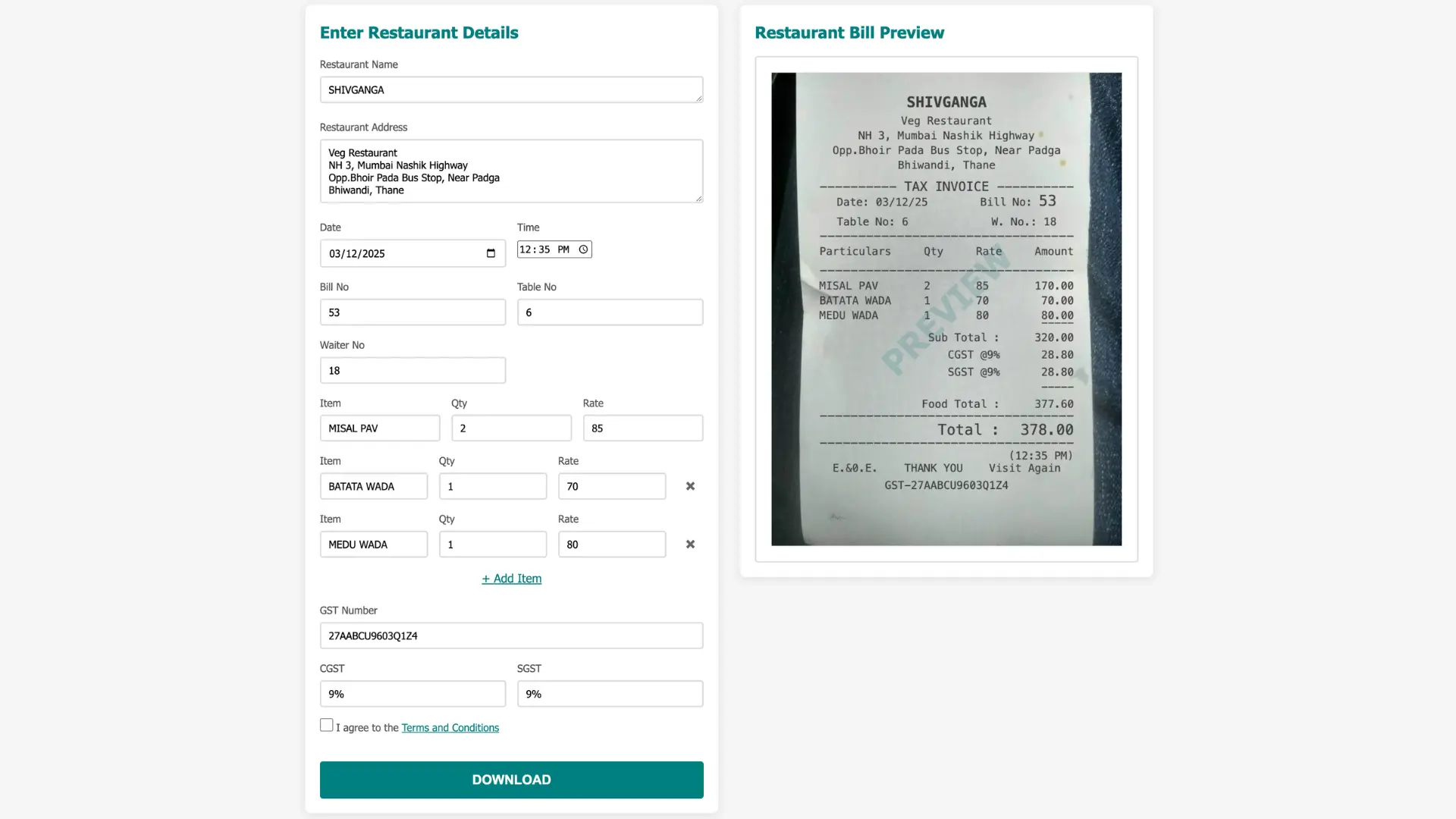
- Generate Invoice: Create GST-compliant invoice with all mandatory details
- Record Transaction: Enter into accounting system immediately
Essential Bill Components:
- Restaurant name, address, contact details, and GSTIN
- Unique invoice/bill number and date
- Itemized list with quantities, unit prices, and totals
- Subtotal, discounts, service charge (if any)
- GST breakdown (CGST, SGST, or IGST)
- Final total amount
- Payment method and transaction details
Payment Methods and Recording:
Different payment methods require different accounting treatment:
- Cash Payments: Record immediately, reconcile daily with cash register
- Card Payments: Record gross amount, note processing fees separately
- UPI/Digital Payments: Record with transaction ID for reconciliation
- Credit/Account Payments: Track separately as accounts receivable
- Split Payments: Document how payment was split (e.g., cash + card)
3. GST Handling and Tax Compliance
GST compliance is mandatory for restaurants with annual turnover above ₹20 lakhs (₹10 lakhs for special category states). Even if you're below the threshold, proper GST handling prepares you for growth.
GST Rates for Restaurants (2026):
- 5% GST (without ITC): Most common rate for restaurants not claiming Input Tax Credit
- 18% GST (with ITC): For restaurants claiming Input Tax Credit on purchases
- 0% GST: Applicable for certain exempted items (check current regulations)
GST Compliance Checklist:
- Obtain GSTIN if turnover exceeds threshold
- Display GSTIN on all invoices and bills
- Issue GST-compliant invoices with all mandatory fields
- Maintain proper GST records (sales, purchases, input tax)
- File GST returns monthly/quarterly as applicable
- Reconcile GST collected vs. GST paid
- Keep all invoices and supporting documents for 6 years
GST Accounting Entries:
For each sale, you need to record:
- Output GST: GST collected from customers (liability)
- Input GST: GST paid on purchases (asset, if ITC eligible)
- GST Payable: Output GST minus Input GST (amount to pay government)
4. Accounting Basics for Restaurants
Understanding basic accounting principles helps you maintain accurate financial records and make informed business decisions.
Key Accounting Concepts:
- Revenue (Income): Money received from food sales, beverages, catering, etc.
- Cost of Goods Sold (COGS): Direct costs of food ingredients, beverages, packaging
- Operating Expenses: Rent, salaries, utilities, marketing, insurance, etc.
- Gross Profit: Revenue minus COGS
- Net Profit: Gross Profit minus Operating Expenses
- Accounts Receivable: Money owed to you by customers (credit sales)
- Accounts Payable: Money you owe to suppliers and vendors
Restaurant-Specific Accounts:
- Food Sales: Revenue from food items
- Beverage Sales: Revenue from drinks (alcoholic and non-alcoholic)
- Food Cost: Cost of ingredients used in food preparation
- Beverage Cost: Cost of beverages sold
- Labor Cost: Salaries and wages for kitchen and service staff
- Rent Expense: Monthly rent for restaurant space
- Utilities: Electricity, water, gas, internet bills
Double-Entry Bookkeeping:
Every transaction affects at least two accounts:
- Example 1 - Cash Sale: Debit Cash (asset increases), Credit Sales Revenue (revenue increases)
- Example 2 - Purchase Ingredients: Debit Food Inventory (asset increases), Credit Cash (asset decreases)
- Example 3 - Pay Rent: Debit Rent Expense (expense increases), Credit Cash (asset decreases)
5. Maintaining Financial Records
Proper record-keeping is essential for tax compliance, financial analysis, and business decision-making.
Essential Records to Maintain:
- Sales Records: All invoices, bills, and receipts issued to customers
- Purchase Records: Invoices from suppliers, vendors, and service providers
- Bank Statements: Monthly statements from all bank accounts
- Cash Register Logs: Daily cash sales summaries and reconciliations
- Payroll Records: Employee salaries, wages, and statutory deductions
- Expense Receipts: All expense receipts (rent, utilities, marketing, etc.)
- GST Records: GST returns, input tax credit records, tax payment receipts
Record-Keeping Best Practices:
- Maintain records daily—don't let them pile up
- Use digital storage with cloud backup for important documents
- Organize by date and category for easy retrieval
- Keep physical copies of critical documents (contracts, licenses)
- Reconcile bank accounts monthly
- Retain records for at least 6 years (as per tax laws)
6. Creating Profit & Loss (P&L) Statements
A Profit & Loss (P&L) statement shows your restaurant's financial performance over a specific period. It's essential for understanding profitability and making business decisions.
P&L Statement Structure:
REVENUE (Top Line)
Food Sales: ₹XXX
Beverage Sales: ₹XXX
Other Revenue: ₹XXX
Total Revenue: ₹XXX
COST OF GOODS SOLD (COGS)
Food Cost: ₹XXX
Beverage Cost: ₹XXX
Total COGS: ₹XXX
GROSS PROFIT = Revenue - COGS: ₹XXX
OPERATING EXPENSES
Salaries & Wages: ₹XXX
Rent: ₹XXX
Utilities: ₹XXX
Marketing: ₹XXX
Other Expenses: ₹XXX
Total Operating Expenses: ₹XXX
NET PROFIT = Gross Profit - Operating Expenses: ₹XXX
Key Metrics to Track:
- Food Cost Percentage: (Food Cost / Food Sales) × 100 (ideal: 28-35%)
- Labor Cost Percentage: (Labor Cost / Total Revenue) × 100 (ideal: 25-35%)
- Prime Cost: COGS + Labor Cost (should be 55-65% of revenue)
- Gross Profit Margin: (Gross Profit / Revenue) × 100 (ideal: 60-70%)
- Net Profit Margin: (Net Profit / Revenue) × 100 (ideal: 10-15%)
7. Cash Flow Management
Cash flow is the lifeblood of any restaurant startup. Managing cash flow effectively ensures you can pay bills, salaries, and suppliers on time.
Cash Flow Components:
- Cash Inflows: Sales revenue, loans, investments, refunds received
- Cash Outflows: Supplier payments, salaries, rent, utilities, taxes, loan repayments
- Net Cash Flow: Inflows minus Outflows (positive = healthy, negative = concern)
Cash Flow Management Tips:
- Maintain a cash reserve (at least 3 months of operating expenses)
- Negotiate payment terms with suppliers (e.g., net 30 days)
- Collect receivables promptly (minimize credit sales)
- Plan for seasonal variations in revenue
- Monitor daily cash position
- Use cash flow forecasting to anticipate shortfalls
8. Best Practices for Startup Restaurants
Following these best practices from day one will save you time, money, and headaches as your restaurant grows.
Workflow Best Practices:
- Automate Where Possible: Use POS systems and accounting software to reduce manual work
- Standardize Processes: Create standard operating procedures (SOPs) for billing and accounting
- Daily Reconciliation: Reconcile cash, card payments, and invoices daily
- Regular Reviews: Review financial reports weekly or monthly
- Separate Business Accounts: Keep business and personal finances separate
- Backup Data: Regularly backup financial data (cloud + local)
- Train Staff: Ensure all staff understand billing and payment processes
9. Common Mistakes to Avoid
Learning from common mistakes helps you avoid costly errors that can hurt your restaurant's financial health.
Common Mistakes:
- Mixing Personal and Business Finances: Makes accounting and tax filing extremely difficult
- Not Recording Small Transactions: Small amounts add up and create discrepancies
- Delaying Record-Keeping: Leads to errors, forgotten transactions, and compliance issues
- Ignoring GST Compliance: Results in penalties and legal issues
- Not Reconciling Bank Accounts: Misses errors, fraud, or missing transactions
- Poor Inventory Management: Leads to food waste, stockouts, and inaccurate COGS
- Not Tracking All Expenses: Understates costs and overstates profits
- Inadequate Cash Flow Planning: Results in inability to pay bills or salaries
10. Recommended Tools and Software
The right tools can significantly streamline your billing and accounting workflow. Here are recommendations for different stages of growth.
For Early-Stage Startups:
- Google Sheets/Excel: Free, simple, good for basic tracking
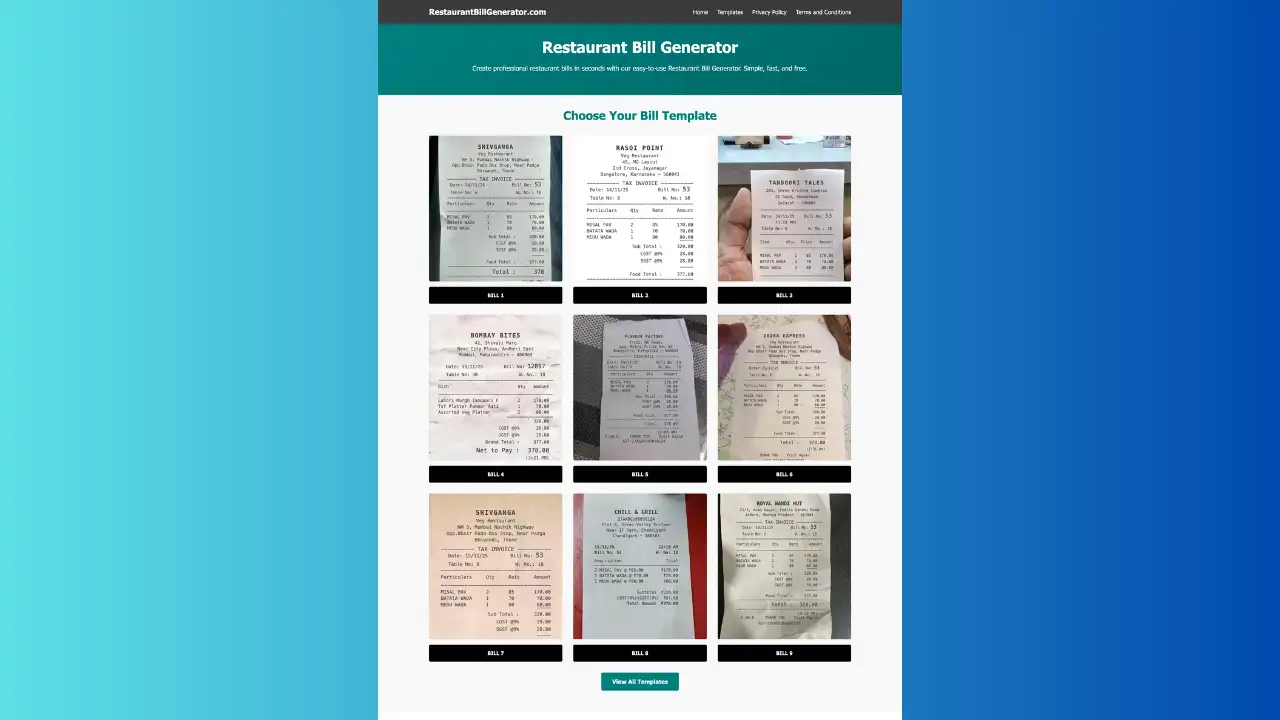
- Free Invoice Generators: Online tools for creating invoices
- Mobile Payment Apps: PhonePe, Google Pay for accepting payments
For Growing Restaurants:
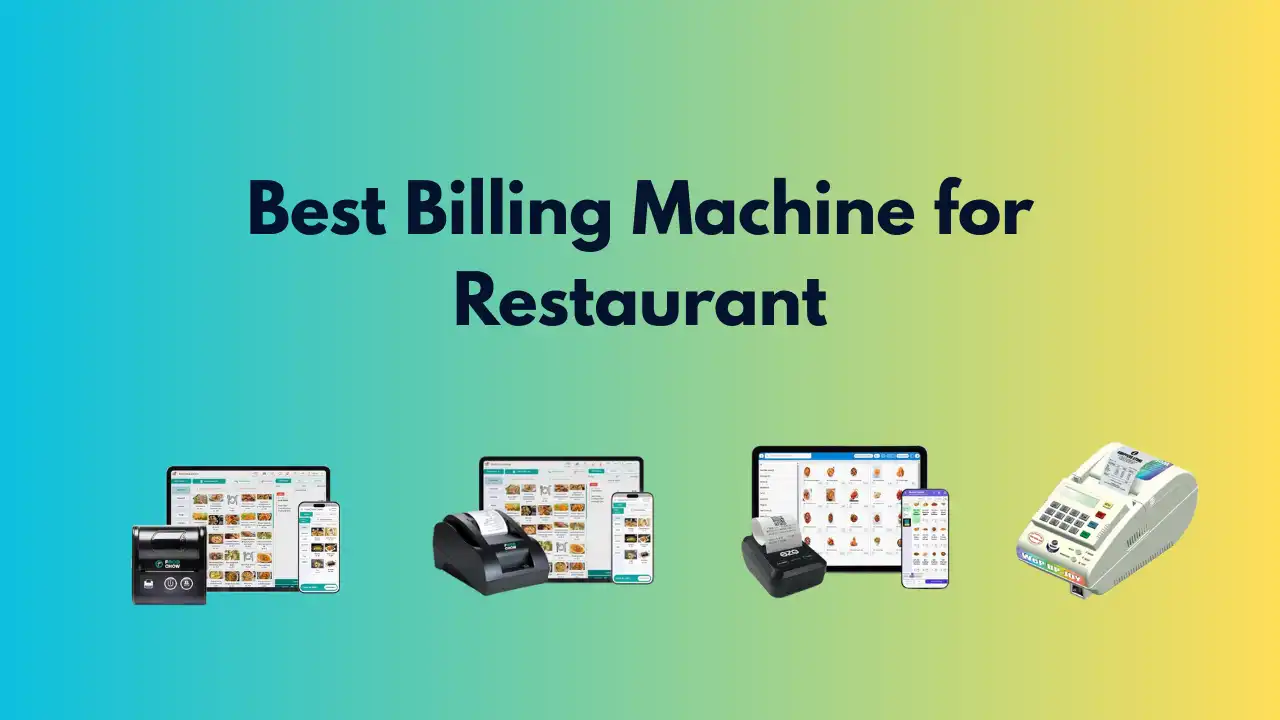
- POS Systems: Square, Zomato POS, or local POS solutions
- Accounting Software: Tally, Zoho Books, QuickBooks
- Inventory Management: Tools integrated with POS or standalone
Tip: Start with free or low-cost tools and upgrade as you grow. The key is to establish good habits early, regardless of the tool you use.
Frequently Asked Questions
1. Do I need GST registration for my restaurant startup?
GST registration is mandatory if your annual turnover exceeds ₹20 lakhs (₹10 lakhs for special category states). Even if below the threshold, voluntary registration can be beneficial for claiming input tax credit.
2. How often should I create P&L statements?
For startups, monthly P&L statements are recommended. As you grow, you may also want weekly reports for better control. Annual P&L statements are required for tax filing.
3. What's the ideal food cost percentage for restaurants?
The ideal food cost percentage is typically 28-35% of food sales. Higher percentages indicate pricing issues or waste, while lower percentages might mean you're underpricing.
4. Should I use cash or accrual accounting?
For small startups, cash accounting (recording when money is received/paid) is simpler. As you grow, accrual accounting (recording when transactions occur) provides better financial insights. GST-registered businesses typically use accrual accounting.
5. How do I handle tips in accounting?
Tips given directly to staff in cash are not recorded as restaurant revenue. Tips added to bills and processed through the restaurant should be recorded as revenue and may be distributed to staff as an expense.
6. What records should I keep for tax purposes?
Keep all invoices, receipts, bank statements, payroll records, GST returns, and expense documents for at least 6 years. Digital copies are acceptable, but ensure they're backed up securely.
7. How do I calculate prime cost?
Prime Cost = Cost of Goods Sold (COGS) + Labor Cost. This should ideally be 55-65% of total revenue. Prime cost is a key metric for restaurant profitability.
8. Should I hire an accountant for my startup restaurant?
For very early stages, you can manage with accounting software. However, hiring a part-time accountant or CA for GST filing, tax planning, and financial advice is highly recommended as you grow.
9. How do I track inventory costs accurately?
Use inventory management software or spreadsheets to track purchases, usage, and stock levels. Conduct regular physical counts and reconcile with records. Calculate food cost by tracking ingredient usage against sales.
10. What's the difference between gross profit and net profit?
Gross Profit = Revenue - Cost of Goods Sold. Net Profit = Gross Profit - Operating Expenses. Gross profit shows profitability of sales, while net profit shows overall business profitability after all expenses.
Conclusion
Establishing a proper billing and accounting workflow from the start is crucial for restaurant startup success. While it may seem overwhelming initially, breaking it down into manageable steps—order management, billing, GST compliance, accounting, and financial reporting—makes it achievable.
Remember:
- Start simple and scale as you grow
- Consistency is more important than perfection
- Regular reviews help identify issues early
- Proper records save time and money in the long run
- Seek professional help when needed (CA, accountant)
By following the workflow outlined in this guide, you'll have a solid foundation for managing your restaurant's finances, ensuring compliance, and making data-driven decisions that drive growth and profitability.
.webp)
.webp)
.webp)